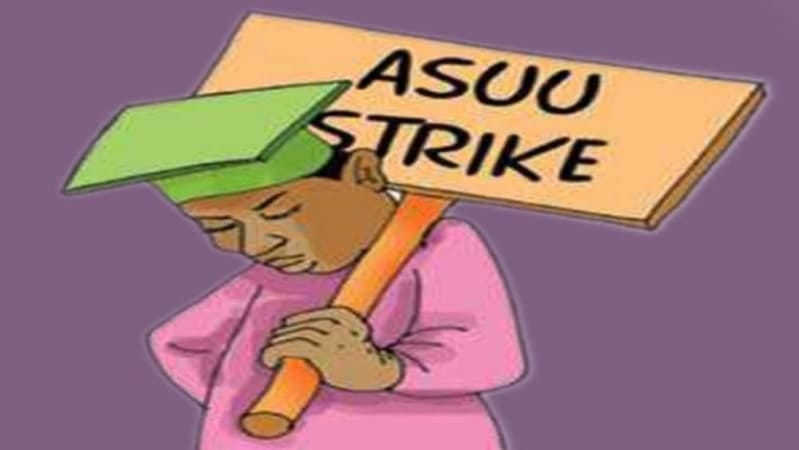
The tension between the Academic Staff Union of Universities (ASUU) and the Federal Government has once again reached a boiling point, as the union officially declared a two-week warning strike beginning midnight on October 13, 2025.
This announcement follows months of failed negotiations and growing frustration within the academic community over the Federal Government’s refusal to address lingering issues affecting public universities. With this latest move, academic activities across Nigerian federal and state universities are expected to be disrupted, leaving millions of students in uncertainty once again.
ASUU Shuns Government Intervention, Says It Has Been Pushed to the Wall
Addressing journalists after an emergency National Executive Council (NEC) meeting, the ASUU National President, Prof. Chris Piwuna, stated that the decision to embark on the warning strike was not made lightly. According to him, the union has exercised patience for too long while the government continues to ignore crucial agreements and commitments made to the Nigerian academic community.
Prof. Piwuna emphasized that the union’s demands have been on the table for years, yet successive administrations have failed to show genuine commitment toward resolving them. He accused the government of paying lip service to education, adding that the current situation reflects a “painful disregard for the future of Nigerian students.”
“We cannot continue to pretend that all is well when the government has refused to act on agreements that are fundamental to the survival of our universities. This two-week warning strike is to remind the authorities that ASUU has limits to its patience,” Prof. Piwuna declared.
Unresolved Issues Fueling the Strike Action
The union outlined several pressing issues that triggered the industrial action, all of which have remained unresolved despite numerous meetings and promises from government officials. These include:
- Renegotiation and Implementation of the 2009 FGN–ASUU Agreement: ASUU insists that the Federal Government must finalize and implement the renegotiated agreement, which focuses on improved welfare, salary structures, and working conditions for lecturers.
- Payment of Withheld Salaries: The union condemned the continued withholding of lecturers’ three-and-a-half months’ salaries and demanded immediate payment without conditions.
- Funding for University Revitalization: ASUU called for renewed and consistent funding of public universities, noting that many campuses across the country are in deplorable condition, with inadequate facilities and poor infrastructure.
- Victimization of ASUU Members: The union cited instances of intimidation and unfair treatment of its members in universities such as Lagos State University (LASU), Prince Abubakar Audu University (Kogi State), and the Federal University of Technology Owerri (FUTO).
Prof. Piwuna stressed that these issues are not new and that the Federal Government’s failure to take decisive action is an insult to the integrity and professionalism of Nigerian lecturers.
Government Appeals for Calm but ASUU Stands Firm
The Federal Government, through the Ministries of Education and Labour, had appealed to ASUU to shelve its strike plans and return to the negotiation table. However, ASUU insists that such calls have become routine tactics used to delay action rather than resolve the real issues.
Prof. Piwuna noted that the government’s latest proposals during the renegotiation process were “provocative and inconsistent” with earlier agreements, further eroding the union’s trust in the negotiation process.
“We have been here before—empty promises, endless committees, and no tangible result. ASUU will no longer be deceived. This strike is a legitimate call for fairness and respect for the education sector,” the president added.
While the government maintains that the door to dialogue remains open, ASUU has made it clear that dialogue without implementation is meaningless.
CONUA Distances Itself from the Strike
Meanwhile, the Congress of University Academics (CONUA), a breakaway academic union, has publicly declared that it will not participate in the ongoing strike. The group stated that there is no valid trade dispute that warrants a work stoppage, adding that it will continue academic activities in institutions where it has members.
This division within the academic community highlights the growing fragmentation among lecturers and could lead to partial academic activity in some universities despite the ASUU strike.
Students, Parents, and Stakeholders React
The National Association of Nigerian Students (NANS) has expressed deep concern over the latest strike, describing it as a setback for education in Nigeria. The student body urged both ASUU and the Federal Government to resolve their differences quickly to prevent yet another prolonged academic shutdown.
NANS noted that repeated strikes have caused enormous damage to students’ academic progression, mental health, and career prospects. Many parents and education advocates also condemned the government’s slow response, warning that the persistent instability in public universities is driving more students to private and foreign institutions, further deepening inequality in access to quality education.
Education analysts say the recurring disputes reflect a larger systemic failure that requires strong political will and genuine investment in the sector.
Potential Consequences of the Warning Strike
If the Federal Government fails to act swiftly within the two-week window, ASUU has warned that the strike will escalate into a total, comprehensive, and indefinite industrial action.
Such escalation could cripple the entire university system, forcing the suspension of lectures, exams, and project defenses nationwide. This would have ripple effects on graduation timelines, postgraduate research, and the general morale of both students and staff.
Observers recall that in 2022, a similar standoff between ASUU and the government led to an eight-month shutdown of public universities — one of the longest in Nigeria’s history. Many fear that history may be on the verge of repeating itself.
ASUU’s Message to Nigerians
In a passionate appeal, ASUU urged Nigerians to understand that its struggle is not just about salary or allowances but about saving public education from total collapse.
“This strike is not a fight against the Nigerian people but a fight for the soul of our universities. We want a system that can compete globally and produce graduates who can proudly hold their own anywhere in the world,” Prof. Piwuna said.
The union also reminded the public that many lecturers continue to work under poor conditions, with outdated equipment, overcrowded classrooms, and unpaid research grants.
Looking Ahead: Will the Government Act Before It’s Too Late?
The next few days will be critical. With the two-week warning strike now in effect, the Federal Government faces mounting pressure to engage meaningfully with ASUU to avert a total shutdown of public universities.
Experts believe that quick, transparent negotiations and concrete actions — not promises — will be key to resolving the impasse.
For now, the fate of millions of students hangs in the balance, as the nation watches to see whether this will mark the beginning of a genuine solution or yet another chapter in Nigeria’s long history of educational crises.