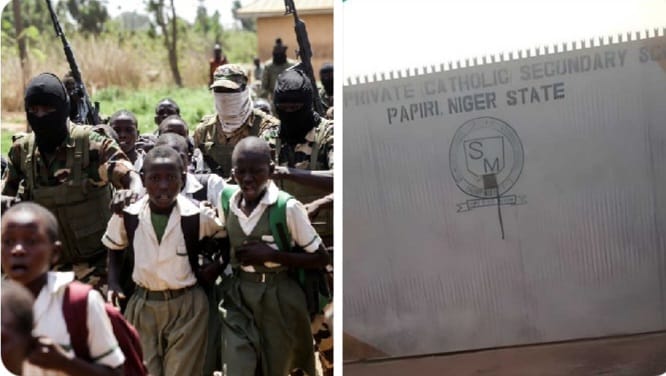
In a deeply troubling escalation, the United States has publicly pressed Nigeria to bring to justice those responsible for the large-scale abductions of schoolchildren in Kebbi and Niger states — as well as to work with the Nigerian government through a newly formed joint counterterrorism working group. The U.S. is now pledging to share intelligence, expedite arms requests, and offer additional security support in response to what many see as a grim turning point in Nigeria’s school-kidnapping crisis.
A Crisis Unfolds
Gunmen launched a deadly raid on Government Girls Comprehensive Senior Secondary School in Maga, Kebbi State, on November 17, killing the vice principal as they abducted 25 young girls.
Just days later, on November 21, the attackers struck again — this time in Niger State, targeting St. Mary’s Catholic Primary and Secondary School in Papiri. Reports indicate 303 students and 12 teachers were taken during this brazen assault. According to the Catholic Diocese of Kontagora, of the 265 people still unaccounted for, 239 are children from the nursery and primary sections.
Some students — about 50 — have managed to escape and reunite with their families. Still, the majority remain in captivity, their exact location unknown.
U.S.–Nigeria Security Cooperation: Moving from Words to Action
In response to the kidnappings, the U.S. government has called for swift and decisive action, making it clear that “those responsible … must be swiftly captured and held accountable.”
To this end, both countries have agreed to establish a Joint Working Group aimed at deepening counterterrorism collaboration. Under this arrangement, the U.S. will:
- Provide enhanced intelligence support
- Accelerate Nigeria’s defense equipment requests
- Possibly supply excess defense articles (depending on availability)
- Offer humanitarian assistance to affected communities
- Help set up early-warning systems for future threats
Importantly, this cooperation is described as “non-binding,” but both governments affirm a shared commitment to protecting civilians. Nigeria’s delegation also used recent diplomatic engagements to challenge what it described as misleading narratives, rejecting claims of genocide or religious targeting and highlighting that violence affects communities across all religious and ethnic lines.
Domestic and Regional Reactions: Outcry & Calls for Justice
Amnesty International Nigeria has sounded the alarm about the long-term effects of school abductions on education in the region. The organization warns that the psychological trauma and fear generated by these attacks will discourage countless families from sending their children to school — particularly in already vulnerable rural areas.
In addition to civil society, INEE (the Inter-Agency Network for Education in Emergencies) has urged security agencies to intensify their efforts to rescue the abducted children and staff. They also call for comprehensive care — including psychological support — for survivors when they return.
The African Commission on Human and Peoples’ Rights has strongly condemned the attacks, saying they violate a range of fundamental rights including the right to education, personal liberty, and security. The Commission is demanding transparent investigations and prosecutions of the perpetrators.
Back home, the Congress of University Academics (CONUA) has described the abductions as a “barbaric” violation of human rights. The union is pushing for stronger school-security strategies, timely rescue operations, and long-term reforms to stem the cycles of violence.
Government Response & Military Strategy
Nigeria’s President Bola Tinubu has personally intervened, sending Vice President Kashim Shettima to Kebbi State to console parents and reaffirm the government’s commitment to rescuing the kidnapped girls. At the same time, Tinubu has redeployed approximately 100,000 police officers previously assigned to VIP protection, directing them instead to community and counter-insurgency duties.
On the military front, Nigeria’s Chief of Army Staff, Lt-Gen. Waidi Shaibu, has ordered troops to “leave no stone unturned” in their rescue operations. He has emphasized the importance of intelligence-driven missions, calling on soldiers to act decisively based on credible leads. The army is also working hand-in-hand with local vigilantes and hunters whose intimate knowledge of the terrain is proving essential.
The Bigger Picture: A Long-Standing Crisis
Sadly, these incidents are not isolated. According to recent data, since the Chibok kidnapping in 2014, there have been at least 92 documented attacks on schools, during which nearly 2,496 students were abducted.
Security analysts suggest that many of these kidnappings are not ideologically driven but financially motivated: armed bandit groups often hold children for ransom. They argue that these criminal networks thrive partly because of weak intelligence infrastructure and the difficulty of securing vast, forested territories.
What’s Next: Risks, Challenges & the Road Forward
- Rescue Operations: The immediate priority remains the safe recovery of the abducted children and teachers. Military operations must be coordinated, intelligence-led, and swift — but also careful not to put hostages at greater risk.
- Intelligence Strengthening: The newly formed U.S.–Nigeria working group offers hope, but long-term success depends on building robust, local intelligence networks. That means better training, improved community reporting mechanisms, and sustainable early-warning systems.
- Accountability & Justice: For any deterrent effect, perpetrators must be held accountable — not just through military action, but through transparent legal processes. Independent investigations (as called by the African Commission) are vital.
- Protecting Education: Without urgent and comprehensive reforms, fear could derail schooling in many northern communities. Governments must invest in infrastructure, community engagement, and child protection to make schools safe again.
- Psychosocial Recovery: For the children who return, the trauma of abduction is deep. Access to trauma-informed counseling, safe spaces, and long-term emotional support must be a major part of any rescue and recovery plan.
This crisis amounts to more than just a security challenge — it’s a threat to the future of education and stability in northern Nigeria. The U.S.-Nigeria security cooperation signals a crucial turning point, but the most important work will happen on the ground: rescuing children, securing schools, and rebuilding trust between communities and the state.