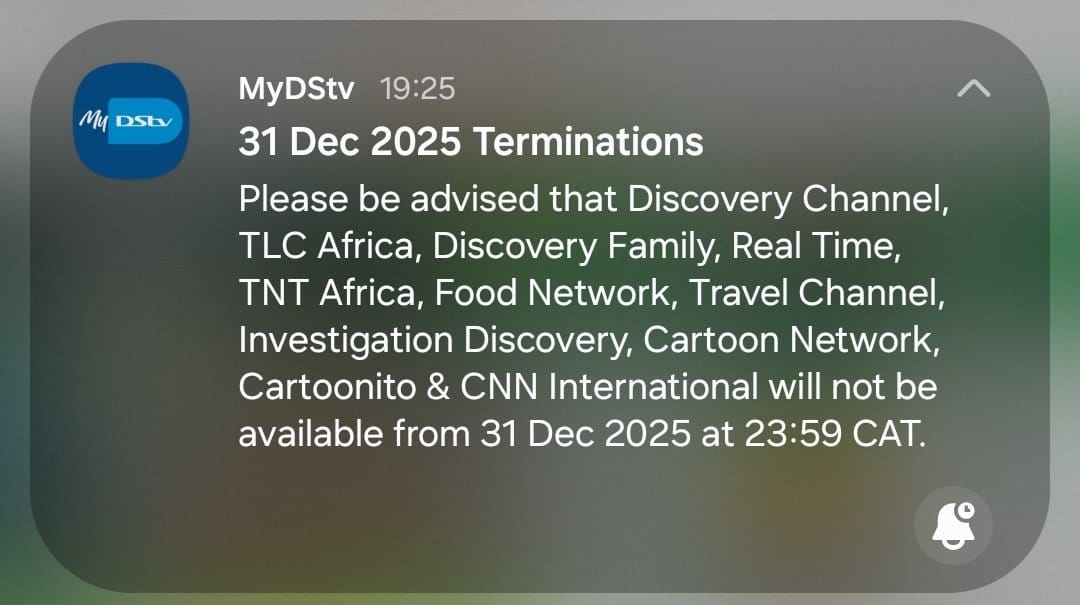
Millions of DStv subscribers across Africa are bracing for a potential content shake-up that could transform the way they consume television. MultiChoice, Africa’s leading pay-TV operator, has issued a warning that up to 12 major channels — including CNN International, Discovery Channel, Cartoon Network, and Food Network — may no longer be available to viewers starting 1 January 2026. The warning comes as negotiations to renew the broadcaster’s carriage agreement with Warner Bros. Discovery (WBD) have reportedly stalled, leaving subscribers in a state of uncertainty.
A Dozen Channels in Jeopardy
The channels at risk cover a wide spectrum of entertainment, news, children’s programming, lifestyle, and documentaries. These include CNN International, Discovery Channel, TLC, Discovery Family, Real Time, TNT Africa, Food Network, HGTV, Investigation Discovery, Cartoon Network, Cartoonito, and Travel Channel. For households that rely on DStv for both educational and leisure content, the loss of these channels could feel seismic. Families with children may lose access to their favorite cartoons, culinary enthusiasts might see popular cooking shows vanish, and news-conscious viewers could be cut off from international coverage.
Industry analysts note that this is not just a minor shuffle in the channel lineup; it is a reflection of broader tensions in the global media landscape, where distribution rights, licensing agreements, and corporate mergers increasingly influence what audiences see on their screens.
Behind the Scenes: Why Channels Are at Risk
The possible blackout is linked to the expiration of the carriage agreement between MultiChoice and WBD, which ends on 31 December 2025. Despite ongoing talks, no renewed agreement has yet been announced. MultiChoice, now part of the French media conglomerate Canal+, has faced mounting pressure in recent years. Subscriber numbers have declined sharply, with the company reporting a loss of 2.8 million linear subscribers over the past two years. Of this total, approximately 1.4 million were in Nigeria alone, reflecting the impact of economic pressures and repeated subscription price increases.
A spokesperson for MultiChoice stated, “While discussions continue, no agreement has been reached at this stage. If the situation remains unchanged, a number of Warner Bros. Discovery channels may no longer be available on DStv from 1 January 2026.” This statement underscores the precarious position of millions of subscribers who have invested in DStv for access to a broad range of programming.
The Impact on Viewers
For viewers across Africa, the potential removal of these channels has serious implications. Children who rely on Cartoon Network and Cartoonito for daily entertainment may have to seek alternative platforms. Families who enjoy food, lifestyle, and home-improvement shows on channels like HGTV, Food Network, and TLC will face a sudden content vacuum. News junkies will feel the absence of CNN International, while documentary enthusiasts lose access to Discovery’s acclaimed factual programming.
The consequences extend beyond mere inconvenience. For many subscribers, DStv represents a primary source of education, entertainment, and family bonding. Losing access to multiple channels simultaneously could undermine the value of their subscriptions, prompting households to reconsider their pay-TV options. Some may look toward streaming services, free-to-air television, or alternative pay-TV providers to fill the gap.
MultiChoice’s Response and Strategic Moves
MultiChoice has indicated plans to refresh its channel lineup in 2026, potentially adding new content to offset any losses. However, the details of this plan remain vague. Industry watchers speculate that the company may focus on expanding local content, sports offerings, or digital streaming options to maintain subscriber loyalty.
At the same time, the situation highlights the fragility of linear television in Africa. Reliance on global content providers like Warner Bros. Discovery means that local broadcasters are vulnerable to contract negotiations and international corporate strategies. Any disruption in agreements can have immediate and far-reaching effects on viewers across the continent.
Broader Implications for Africa’s Media Landscape
The potential removal of these 12 channels may accelerate an ongoing shift in the African pay-TV market. As economic pressures mount and consumer behavior evolves, viewers increasingly favor on-demand streaming services over traditional satellite subscriptions. Pay-TV providers, faced with declining subscriber numbers and rising costs, may need to invest more heavily in local content and digital delivery platforms to remain competitive.
Analysts also note that this could mark a turning point in the relationship between international content providers and African broadcasters. The outcome of the MultiChoice-WBD negotiations could set a precedent for future agreements, affecting content accessibility, pricing, and the overall media ecosystem across the continent.
Looking Ahead
As negotiations continue behind closed doors, all eyes remain on MultiChoice and Warner Bros. Discovery. The potential delisting of these 12 channels on 1 January 2026 represents one of the most significant disruptions to African pay-TV in recent years. For viewers, the coming weeks will be critical in determining whether DStv maintains its broad spectrum of content or faces a reduced lineup that fundamentally changes the viewing experience.
Whether this challenge will lead to innovation, a renewed content strategy, or subscriber churn remains to be seen. What is clear, however, is that the outcome will shape the future of pay-TV in Africa, highlighting the delicate balance between global content providers and regional broadcasters.