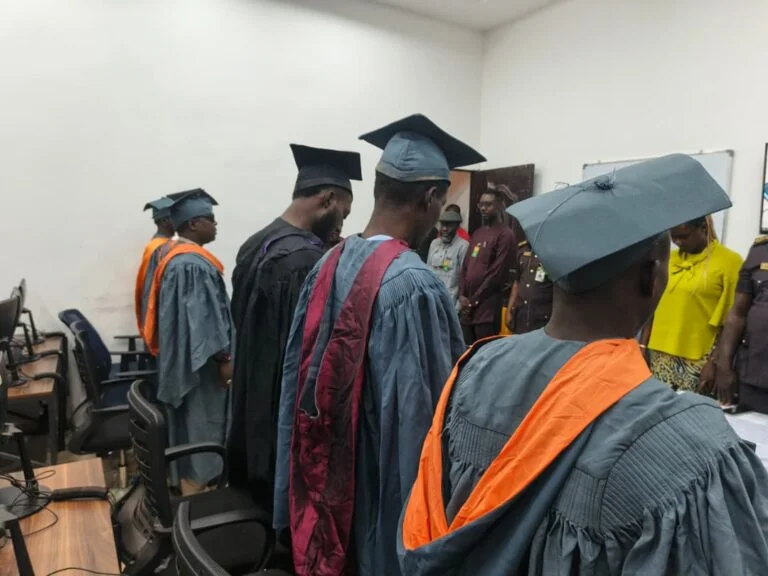
In a powerful demonstration of the transformative power of education, the National Open University of Nigeria has awarded university degrees to six inmates of the Medium Security Custodial Centre in Kuje, Abuja. The milestone event has reignited national conversations around rehabilitation, second chances, and the role of education in reshaping lives within Nigeria’s correctional system.
The graduation ceremony, held within the custodial facility, was more than a formal academic exercise. It was a symbolic moment that underscored hope, resilience, and the possibility of personal renewal even in the most restrictive circumstances.
Education as a Tool for Rehabilitation
The National Open University of Nigeria has long championed inclusive education, extending learning opportunities to underserved and unconventional populations. By offering academic programmes within custodial centres, the institution reinforces the idea that incarceration should not end a person’s pursuit of knowledge or self-improvement.
For the Nigerian Correctional Service, the programme aligns with its broader reform agenda, which prioritises rehabilitation over punishment. Education is seen as a critical pathway for preparing inmates for productive reintegration into society upon release.
Academic Achievements Against the Odds
The six inmates successfully completed their studies through NOUN’s flexible open and distance learning system, balancing academic demands with the realities of custodial life. Their achievements reflect discipline, commitment, and determination in an environment often marked by limited resources and restricted freedoms.
The graduates earned a mix of postgraduate and undergraduate qualifications across relevant and socially impactful disciplines. These included master’s degrees in Peace Studies and Conflict Resolution, as well as bachelor’s degrees in Peace Studies and Conflict Resolution, Political Science, Criminology, and Security Studies.
These fields are particularly significant, as they equip graduates with knowledge directly connected to governance, security, social stability, and conflict management.
Strong Institutional Support
Officials of the Nigerian Correctional Service commended the graduates for their perseverance and academic excellence. They emphasised that education remains one of the most effective tools for reducing recidivism and empowering inmates with skills that can support lawful livelihoods after release.
Correctional authorities also highlighted the importance of partnerships between educational institutions and custodial centres, noting that such collaborations help humanise correctional facilities and restore dignity to inmates.
Representatives of the National Open University of Nigeria described the programme as a pathway of hope, stressing that learning should never be limited by physical location or social status. According to them, education within custodial centres is proof that knowledge can thrive anywhere it is nurtured.
Voices From Within the Custodial Centre
One of the graduating inmates described the academic journey as life-changing, explaining that studying gave them renewed purpose and a sense of identity beyond incarceration. The opportunity to earn a degree restored confidence and offered a vision of a more meaningful future.
Such testimonies highlight the psychological and emotional benefits of education, not just its economic value. For many inmates, learning becomes a stabilising force that encourages reflection, growth, and responsible citizenship.
A Broader Message to Society
The graduation of inmates at Kuje sends a strong message to the wider society about the importance of second chances. It challenges stereotypes about inmates and reinforces the idea that many incarcerated individuals can still contribute positively if given the right support and opportunities.
It also raises important policy questions about expanding educational programmes across correctional facilities nationwide. Advocates argue that scaling such initiatives could significantly reduce crime rates, ease post-release reintegration, and strengthen national development.