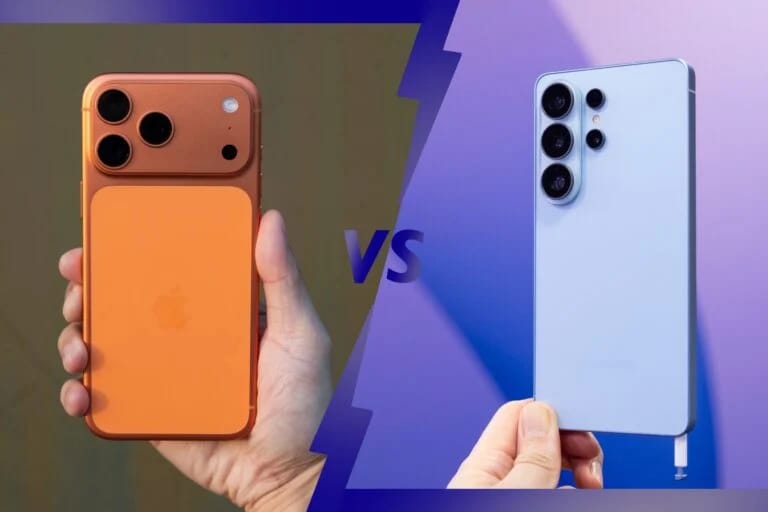
The 2026 flagship showdown between Samsung and Apple is less about raw hardware and more about artificial intelligence. Both companies deliver premium smartphones, but their focus diverges when it comes to integrating AI into the user experience. From performance and display to battery life and cameras, these devices are neck-and-neck—but AI may ultimately be the defining factor.
Pricing: Premium vs. Competitive
The Galaxy S26 lineup is positioned at a higher price point:
- S26: approximately $900
- S26+: approximately $1,100
- S26 Ultra: approximately $1,300
Meanwhile, the iPhone 17 series is slightly more accessible at launch:
- iPhone 17: approximately $800
- iPhone 17 Pro Max: approximately $1,200
Apple maintains a lower entry price, while Samsung’s Ultra model targets premium buyers seeking maximum performance and features.
Design and Build: Subtle Differences
Both Samsung and Apple have refined their industrial designs:
- Aluminum frames are standard across both lineups.
- The iPhone 17 retains the Action Button, a programmable shortcut for custom actions.
- The Galaxy S26 base model is slightly lighter than the iPhone 17.
Visually, differences are subtle, with branding and camera layouts being the most immediately noticeable distinctions.
Display Technology: Innovation vs. Accuracy
Galaxy S26 Ultra offers:
- A larger, higher-resolution display
- Exclusive Privacy Display technology that limits visibility from side angles
iPhone 17 focuses on:
- Slightly higher pixel density on the base model
- Accurate color calibration and optimized brightness
Samsung emphasizes display innovation and feature differentiation, while Apple prioritizes visual accuracy and efficiency.
Performance: Power Meets Optimization
The Galaxy S26 lineup is powered by the Snapdragon 8 Elite Gen 5 processor with up to 16GB RAM, providing impressive benchmark scores.
The iPhone 17 is equipped with Apple’s A19 chip and up to 12GB RAM, benefiting from tight integration between iOS and hardware for consistently smooth performance.
While Samsung leads on paper in memory and raw specs, Apple’s optimized ecosystem ensures excellent real-world performance.
Cameras: Mega Pixels vs. Computational Mastery
Galaxy S26 / S26+
- Triple-lens camera setup
Galaxy S26 Ultra
- Quad-lens configuration
- 200MP main sensor
- Dual telephoto lenses for advanced zoom capabilities
iPhone 17
- Dual cameras on base models, triple on Pro
- Renowned for video quality, HDR, and computational photography
Samsung dominates in zoom range and sensor megapixels, especially with the Ultra model. Apple continues to excel in image processing, video stabilization, and color accuracy.
Battery and Charging: Endurance vs. Efficiency
The Galaxy S26 Ultra features a 5,000mAh battery and supports fast wired charging up to 60W.
The iPhone 17 has a smaller battery but leverages iOS optimization for longer efficiency and includes robust wireless and MagSafe charging options.
Samsung offers faster charging, while Apple emphasizes long-term battery health and efficient usage.
Artificial Intelligence: The Defining Factor
Samsung’s AI Advantage
Samsung markets the Galaxy S26 as an “agentic AI phone,” designed to act on behalf of the user rather than merely respond. Key features include:
- Context-aware recommendations
- Automated cross-app actions
- Advanced AI photo and video editing
- Smart task execution such as scheduling, navigation, and ordering services
Apple’s AI Approach
The iPhone 17 continues to enhance Apple Intelligence, including:
- Smarter Siri integration
- On-device processing for privacy
- Contextual suggestions across apps
Apple’s AI improvements are more incremental, focused on refinement rather than proactive automation.
Verdict: Which Flagship Should You Choose?
Both phones excel in performance, display, camera quality, and battery life. The key differentiator is AI integration:
- Choose Galaxy S26 if you want cutting-edge AI features, higher RAM, and innovative hardware like the Privacy Display and advanced zoom cameras.
- Choose iPhone 17 if you value Apple’s ecosystem, software optimization, and slightly lower entry pricing.
In 2026, the smartphone race is no longer about raw specs alone—intelligent AI features and ecosystem integration are now the ultimate measures of a flagship device.