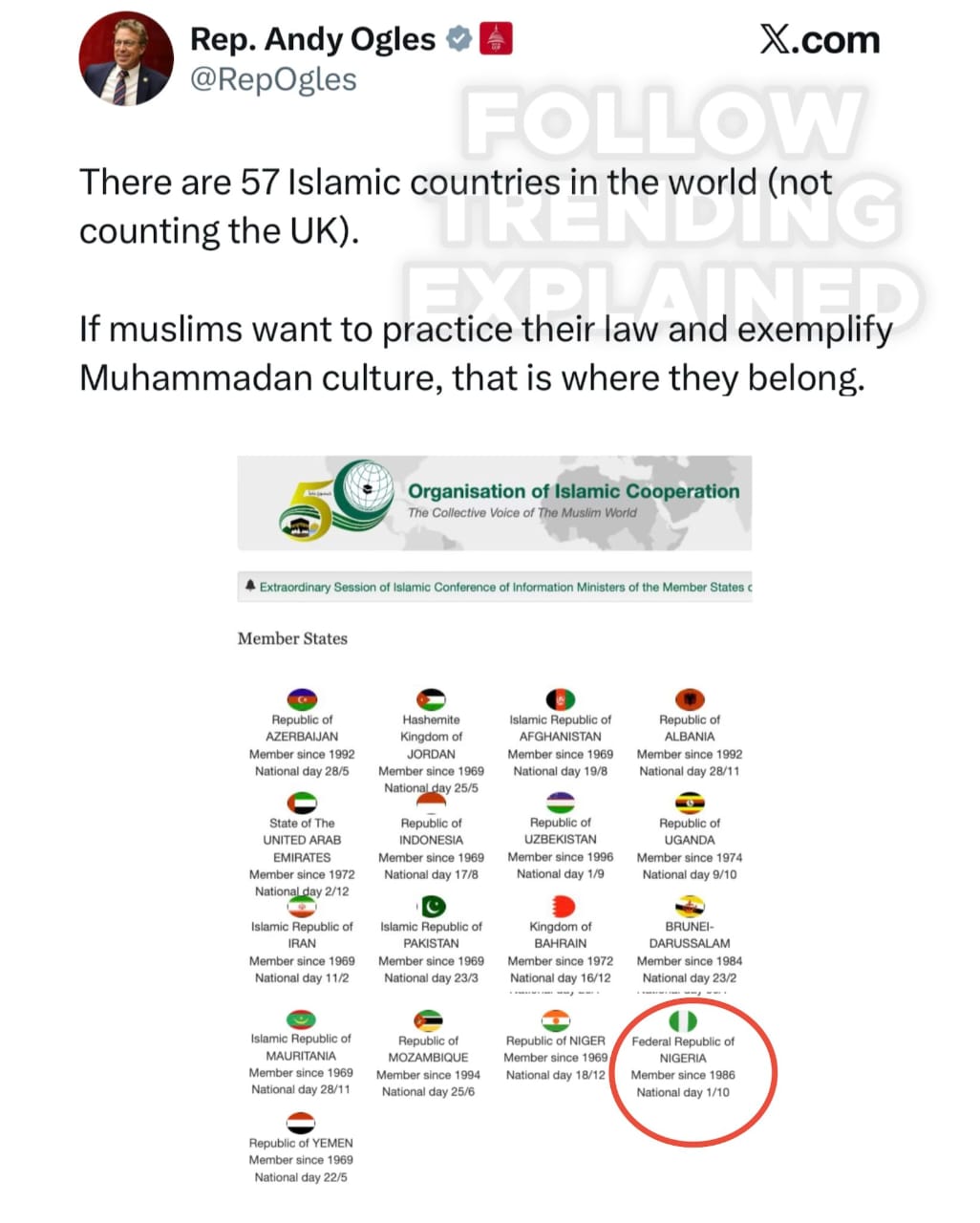
Nigeria has found itself at the center of a heated online debate after claims surfaced on social media suggesting that the country is officially a Muslim nation and that it is aligned with Islamic countries in global geopolitical conflicts.
The controversy began when Andy Ogles, a member of the United States House of Representatives, shared a list of countries he described as Islamic nations. In his message, he advised Islamic extremists to move to any of the listed countries instead of trying to impose religious practices in the United States.
Among the countries on that list was Nigeria.

His post quickly drew attention from Nigerians online, many of whom rejected the characterization and insisted that Nigeria is a secular state with a diverse religious population.
The conversation intensified further when a pro-Palestinian commentator identified as Dr. Moyi circulated another list reportedly sourced from an Iranian page. That list claimed that Nigeria was among countries backing Iran in the ongoing geopolitical tensions in the Middle East.
The list grouped Nigeria alongside several countries described as supporters of Iran, including Russia and China, as well as a number of Muslim-majority states.

This triggered a wave of reactions from Nigerians across social media platforms, particularly on X, where users strongly disputed the claim and demanded that Nigeria be removed from both lists.
Many Nigerians argued that while the country has significant Muslim and Christian populations, it remains constitutionally secular and should not be categorized as an Islamic state.
The OIC Membership at the Center of the Debate
One key fact repeatedly cited in the online discussions is Nigeria’s membership in the Organisation of Islamic Cooperation (OIC), an intergovernmental body made up of dozens of countries with Muslim populations.
Nigeria formally joined the organization in 1986 during the military administration of Ibrahim Babangida.
At the time, the government explained that the decision was largely diplomatic and economic. According to Babangida, joining the organization was intended to expand Nigeria’s international partnerships and increase its global influence, particularly with countries in the Middle East and other regions.
However, the move was controversial from the beginning because Nigeria is not officially an Islamic state and has a nearly equal population of Christians and Muslims.
After Babangida left office, his successor Sani Abacha did not withdraw Nigeria from the organization and instead maintained the country’s membership.
Years later, the issue resurfaced again when former president Goodluck Jonathan attended an OIC summit in Cairo, Egypt in 2013, further confirming Nigeria’s continued participation in the body.
Today, Nigeria remains a full member of the Organisation of Islamic Cooperation alongside 56 other countries.
Why Nigerians Are Pushing Back
Despite the historical membership, many Nigerians insist that participation in an international organization does not change the country’s constitutional identity.
Nigeria’s constitution recognizes the nation as a secular state where no single religion is adopted as the official religion of government. Because of this, several commentators argue that labeling Nigeria as an Islamic country oversimplifies its complex religious and political landscape.
Others also pointed out that the viral lists circulating online may have been created for political messaging or social media engagement rather than for accurate geopolitical classification.
The result has been a flood of posts from Nigerians demanding that their country be removed from lists portraying it as either an Islamic state or a participant in foreign religious conflicts.
A Debate That Reflects Nigeria’s Complex Identity
The controversy highlights a long-standing sensitivity in Nigeria’s political discourse: the delicate balance between religion and state.
While Nigeria maintains diplomatic relations with countries across different regions and organizations, discussions about religion and national identity often generate strong reactions from citizens.
As the debate continues to spread online, many Nigerians are using the moment to revisit the history of Nigeria’s membership in the Organisation of Islamic Cooperation and what it means for the country’s international image.
To better understand the public reaction, scroll down to view comments from concerned Nigerians on X, where citizens are sharing their opinions, criticisms, and questions about the claims currently trending online.

Credit: Trending Explained