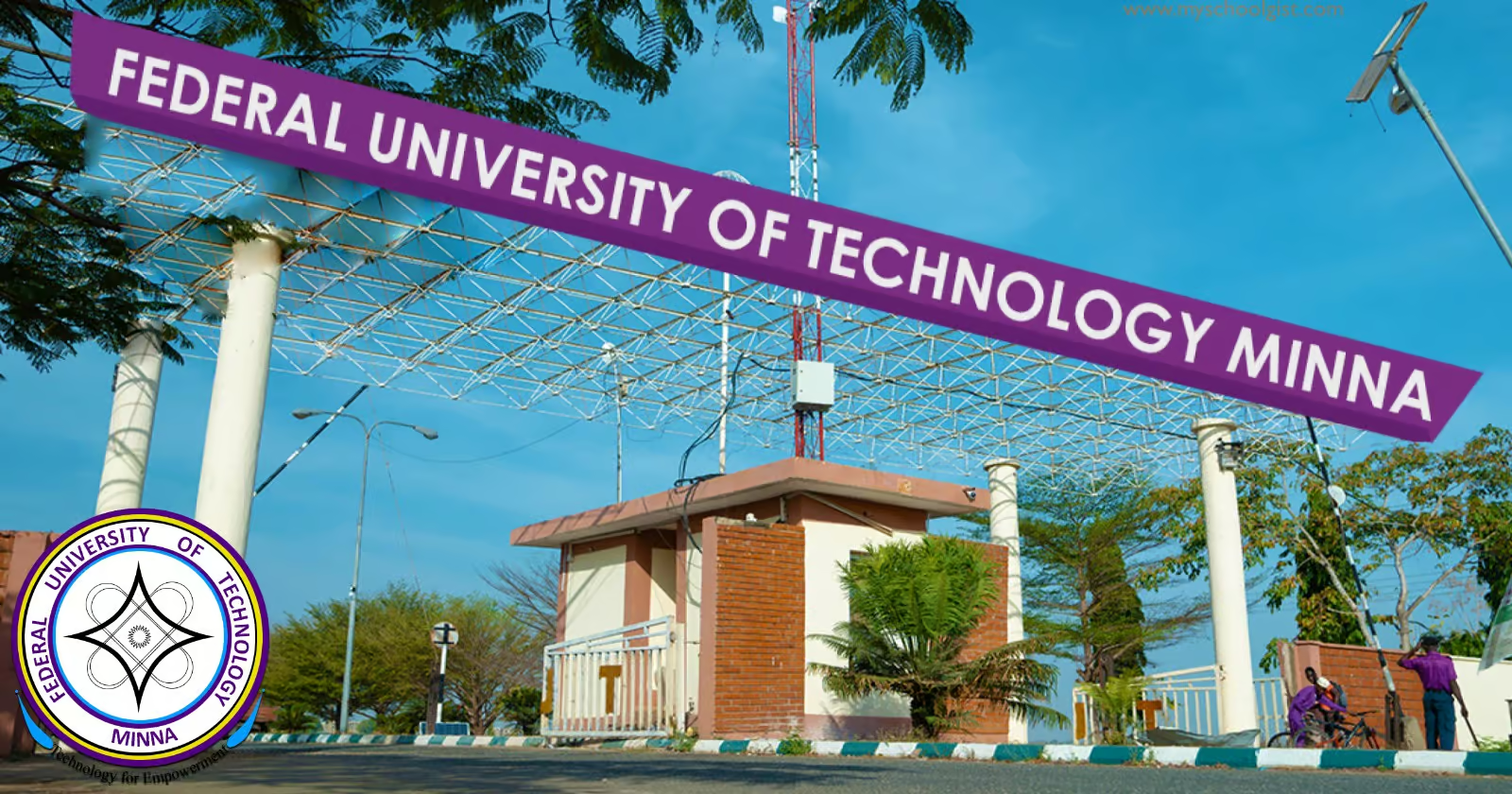
The Vice-Chancellor of the Federal University of Technology Minna (FUT Minna), Professor Faruk Adamu Kuta, has raised serious concern over what he described as the crushing financial burden imposed on the institution by electricity charges from the Abuja Electricity Distribution Company (AEDC).
Speaking during activities marking the university’s 34th Convocation Ceremony and 43rd Founders’ Day celebration held on February 1, 2026, Prof. Kuta revealed that FUT Minna’s classification under the Band A electricity tariff has resulted in unusually high monthly bills that are steadily draining the university’s resources and affecting its ability to fund critical student-focused services.
Addressing journalists and dignitaries at the event, the Vice-Chancellor spoke candidly about the situation.
“When students are in session, we pay about ₦80 million every month for electricity. That is the reality we are facing as an institution,” he said.
He explained that the Band A category, which attracts the highest tariff under Nigeria’s service-based electricity pricing system, is typically associated with customers expected to enjoy near-constant power supply. However, he argued that the university’s experience does not reflect the level of supply that would justify such enormous billing.
“We are a teaching and research institution, not a commercial enterprise, yet our internally generated revenue is being channeled into electricity bills. This has diverted resources that should have been used for students’ welfare, transportation, and infrastructure,” Prof. Kuta stated.
The Vice-Chancellor pointed specifically to the transportation difficulties on campus as an example of how the financial strain is affecting students directly.
“If not for these electricity costs, we would have been able to invest more in buses and campus mobility for our students and staff. Instead, we are forced to commit a huge portion of our funds to power bills that do not reflect the supply we receive.”
He stressed that over two academic semesters — roughly eight months of student residency — the university spends an estimated ₦640 million annually on electricity alone. According to him, this amount could significantly transform campus infrastructure, student housing, and learning facilities if redirected.
“We pay for high-band electricity as if we are a commercial consumer. It is eroding funds meant for academic development and the welfare of our university community,” he added.
Prof. Kuta disclosed that the university management has begun engaging relevant authorities, including regulatory bodies and federal stakeholders, in search of relief and possible reclassification.
“We have opened communication with the necessary agencies and ministries on this matter. We are also exploring alternative sources of energy that will be more sustainable and cost-effective for the university.”
Despite the heavy financial challenge posed by electricity costs, the Vice-Chancellor used the occasion to highlight major achievements recorded by the institution.
He announced that FUT Minna recently secured a ₦1 billion agricultural commercial farm grant from the Tertiary Education Trust Fund (TETFund), placing the university among the top beneficiaries nationwide. He also revealed that the university attracted over $3 million in international research funding for ICT development, alongside a £15,000 Open Access Books grant from the United Kingdom.
“These milestones show that FUT Minna is growing in research strength and international relevance. We are determined not to allow these electricity challenges to slow down our progress,” he said.
Prof. Kuta further noted that the university’s College of Medical Sciences and Health Technology has received full approval and commenced academic activities, describing it as another landmark achievement for the institution.
He concluded by assuring the university community that the management remains committed to finding lasting solutions.
“We are pressing every available button to ensure that this issue is addressed. Our priority remains the welfare of our students, staff, and the continued development of this great institution.”
The Vice-Chancellor’s remarks have drawn attention to the broader impact of Nigeria’s electricity tariff structure on large public institutions, particularly universities that operate extensive campuses but are not structured as commercial enterprises.