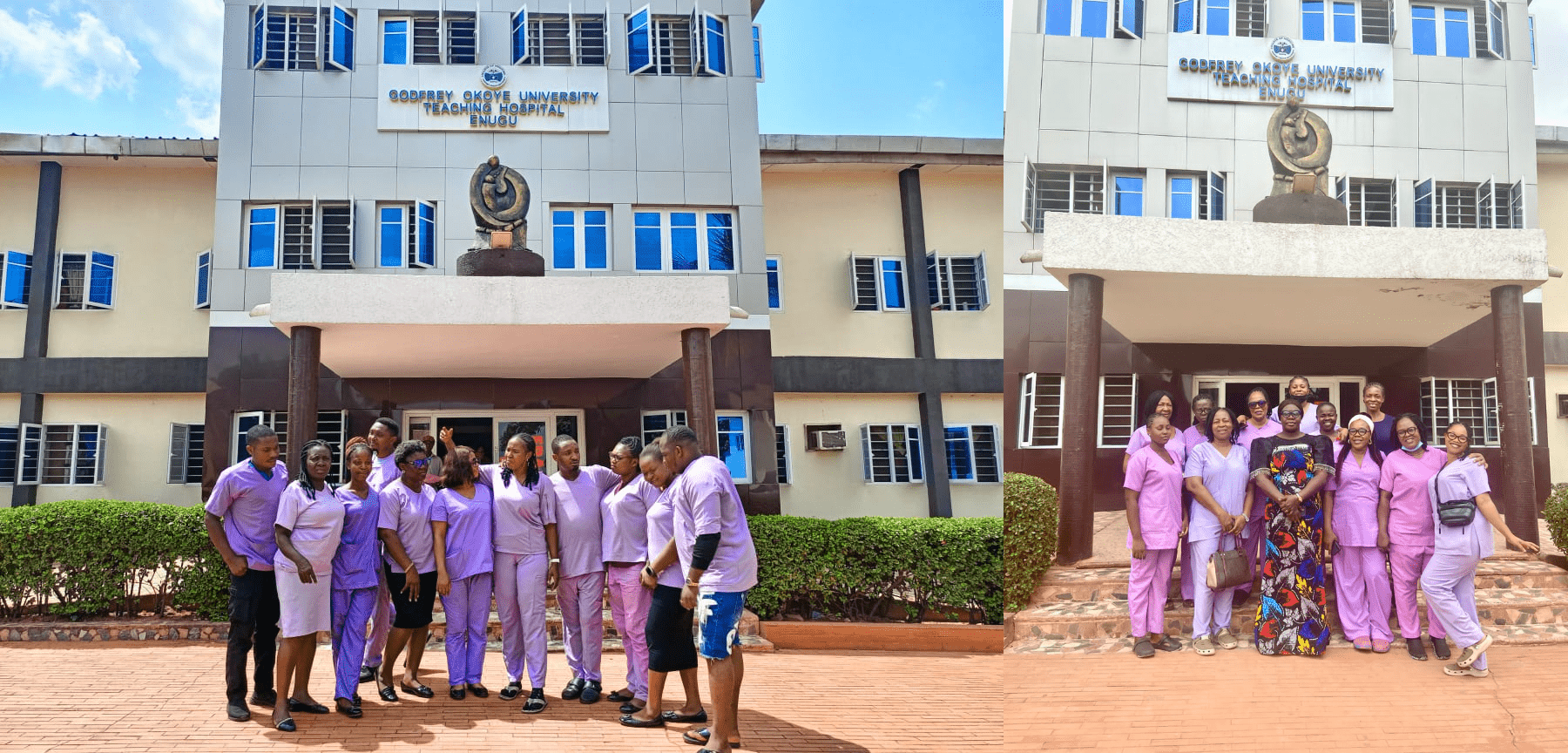
Godfrey Okoye University (GO University) has just marked a major milestone: the formal establishment of its own fully-functional teaching hospital — GO University Teaching Hospital (GOUNITH), located in Enugu. According to the University’s Vice-Chancellor, this makes GO University “one of the few private universities in Nigeria” with its own medical teaching hospital.
This isn’t just a nominal change. GOUNITH — formerly a mission hospital — has been upgraded to a 200-bed facility with modern infrastructure and a wide range of specialties, positioning it as both a training ground for future doctors and a serious healthcare provider for the community.
What the New Teaching Hospital Offers
GO University Teaching Hospital brings a comprehensive package of services and infrastructure designed to support medical education and offer quality patient care:
- The hospital features a large Accident & Emergency (A&E) department, including a dedicated Children’s unit — described as among the largest of its kind in any Nigerian teaching hospital.
- It’s equipped with modern diagnostic and treatment facilities: X-ray, CT scans, ultrasound machines, dialysis centre, and more — showing that the institution is serious about matching, or coming close to, standard teaching-hospital capabilities.
- A wide array of medical specialties are covered: Paediatrics, general surgery, orthopaedics, urology, ENT, gynaecology & antenatal care, psychiatry/psychology, ophthalmology, nephrology, neurology, cardiology, plastic surgery, internal medicine, occupational health, among others.
- The hospital is already functional: it has reportedly carried out successful brain surgeries, demonstrating capacity for complex procedures and not just routine or basic healthcare.
- An Intensive Care Unit (ICU) is slated to open soon — indicating commitment to critical-care readiness.
- For students, the hospital offers a clean, modern, well-organized clinical environment for hands-on training — a much stronger platform than reliance on overcrowded public hospitals or external attachments.
Together, these features make GOUNITH more than a “school hospital” — it’s positioning itself as a full-fledged tertiary-care and teaching facility.
Why This Matters — For Education, Health, and the Community
Improving Medical Education Standards
One of the perennial challenges for medical training in Nigeria — especially in private universities — is finding adequate hospitals for clinical attachments. Overcrowding in public teaching hospitals, limited infrastructure, and high demand often compromise the practical training component.
By establishing its own teaching hospital, GO University bypasses these constraints. The University now controls both the academic and clinical environments. That means better scheduling, more availability for student rotations, superior oversight of training quality, and a cohesive medical-school “ecosystem.” The Vice-Chancellor emphasized that this will allow GO University to “be completely in charge of the quality of our medical students and doctors.”
Expanding Healthcare Access in Enugu Region
For residents of Enugu and environs, GOUNITH provides a new option for specialized healthcare services — especially in fields such as neurosurgery, paediatrics, obstetrics and gynaecology, orthopaedics, diagnostics, and emergency care.
Earlier, the institution had commissioned a “Mother and Child” unit to address maternal and infant care needs — a response to high maternal and infant mortality rates previously noted by state authorities.
As a faith-based institution with deep local roots (GO University is owned by the Catholic Diocese of Enugu), GOUNITH may combine community sensibilities with medical professionalism — which could help build trust and encourage people to seek care earlier.
Setting an Example: Private Sector’s Role in Health Infrastructure
GO University’s move reflects a broader trend: private institutions stepping up to bridge gaps in healthcare delivery and medical training. This is crucial in a country where public hospitals are often overstretched.
Other private and public universities are also exploring or launching teaching-hospital facilities — but each new operational teaching hospital adds capacity, improves access, and offers competition that pushes quality upward.
If successful, GO University’s model could encourage more private universities to replicate it — helping to increase the number of trained doctors, reduce pressure on public teaching hospitals, and expand healthcare reach across Nigeria.