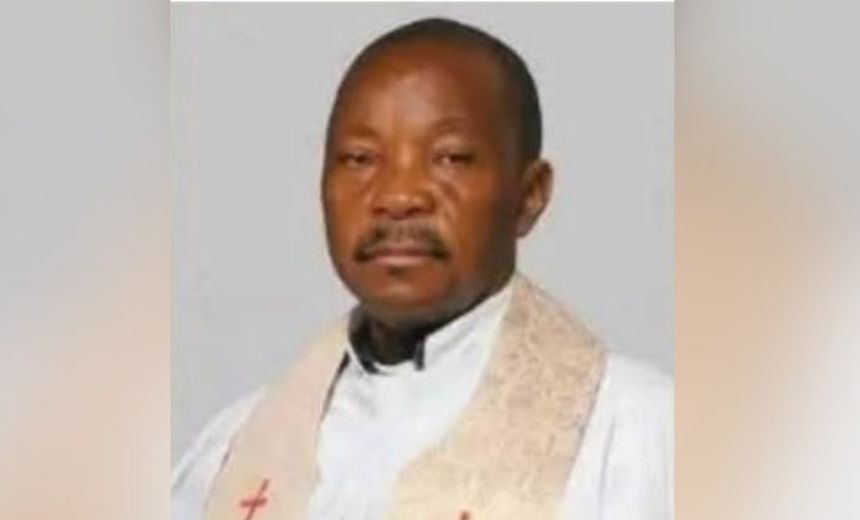
The anguish within Kaduna State deepened this week as the death of Venerable Edwin Achi, the priest of Ebenezer Anglican Church in Nissi community, Chikun Local Government Area, was confirmed by the Diocese of Kaduna. The cleric, who was abducted alongside his wife and daughter on 28 October 2025, died while in the custody of his abductors — a development that has sent shockwaves through religious circles, security observers, and the wider Nigerian public.
The story began on a quiet evening when heavily armed kidnappers stormed the priest’s residence, located not far from the Kaduna Refinery axis, and took the family away after a violent invasion of their home. The attackers left the community in chaos, igniting fear and uncertainty among residents who say the region has increasingly become a target for criminal groups.
In the days after the abduction, the kidnappers reportedly made contact with the family and demanded a staggering ransom of six hundred million naira for the release of the victims. As relatives, church members, and the entire Anglican communion prayed for a breakthrough, expectations gradually turned into dread when communication ceased.
That dread confirmed itself when church authorities announced that Venerable Achi had died in captivity. The Diocese described the news as “a painful blow to the entire Anglican family,” mourning a man widely regarded as a humble, devoted, and selfless servant of God. His death, they said, represents a devastating symbol of the growing vulnerability of clerics and community leaders in Nigeria’s conflict-prone regions.
Yet the tragedy is not complete. The priest’s wife — a customs officer — and their daughter remain in captivity. Their whereabouts, health condition, and the intentions of the kidnappers remain unknown. The Diocese has continued to appeal for their safe return as security agencies intensify efforts to locate them.
A Community Shattered by the Loss of a Spiritual Leader
To many in Nissi community and the broader Anglican fellowship in Kaduna, Venerable Achi was more than a church administrator — he was a mentor, mediator, counselor, and community stabilizer. His parishioners recall his calm approach to conflict, his dedication to pastoral visits, and his unwavering commitment to service regardless of rising risks in the region.
The Diocese’s leadership responded with unprecedented grief, immediately cancelling its major 2025 programme, “Stand Up for Jesus,” in honour of the late priest. The decision reflects the depth of sorrow felt across the church, with clergy members describing his death as “an assault on the faith community.”
Residents of Ungwan Maijero, where the church is located, remain in fear. The incident, they say, is part of a series of violent kidnappings that have plagued Chikun LGA, turning once stable neighbourhoods into danger zones. Families now worry that no one — not even highly visible religious figures — is shielded from the reach of criminal networks.
A Mirror to Nigeria’s Worsening Security Crisis
The death of Venerable Achi highlights a crucial and troubling reality: Nigeria’s insecurity has now eroded into spaces once considered untouchable. The targeting of a priest, abducted from his home and killed despite being held for ransom, reinforces how deeply entrenched criminality has become in parts of Northern Nigeria.
In recent years, religious leaders — both Christian and Muslim — have been increasingly victimized by kidnappers who now view clerics as high-value targets. This trend raises disturbing questions about the capability of armed groups and the gaps within Nigeria’s security architecture.
The fact that a respected spiritual leader could be abducted and killed, even as a ransom negotiation was underway, exposes the fragile state of law enforcement in such regions. Communities now contend not only with fear but with a sense of abandonment. Residents lament that security presence is often reactionary rather than preventive, allowing criminal elements to operate with startling boldness.
The tragedy also underscores a deeper emotional toll: insecurity is no longer a distant headline, but a lived experience — affecting families, professionals, students, traders, and now clergy members who once stood as beacons of hope.
Calls for Justice, Security Reform, and a National Response
The killing has triggered widespread calls for accountability and urgent government intervention. Analysts and community leaders emphasize that this is not merely a local crime but a national security failure that must be addressed with seriousness and transparency.
First, there is an immediate demand for an intensive manhunt to rescue the priest’s wife and daughter, whose fate hangs in balance. The continued silence from their captors has only intensified fears, making their rescue a critical priority.
Second, stakeholders insist on a full investigation into the circumstances surrounding the abduction and death of the priest. Nigerians want answers: Who perpetrated the attack? Was there a missed opportunity for intervention? What intelligence was available? How can future attacks be curtailed?
Third, experts argue that the government must rethink its approach to rural security — moving from reactive deployments to improved intelligence, community policing partnerships, and early-warning systems that disrupt criminal plans before they unfold.
Additionally, civil society and religious bodies are urging unified action. They want solidarity across faiths, political lines, and regions to condemn such attacks and compel authorities to act decisively against criminal elements.
A Tragic Symbol and a Test of National Resolve
The death of Venerable Edwin Achi is more than the passing of a cleric — it is a haunting reminder of the fragility of safety in many Nigerian communities. His killing has left behind a grieving congregation, a traumatized neighbourhood, and a family torn apart by violence.
As prayers continue for the safe return of his wife and daughter, Nigerians are confronted with deeply troubling but necessary questions: How many more lives must be lost before decisive action is taken? What does it say about national security when a priest cannot sleep safely in his own home? And how long will citizens live at the mercy of armed groups?
The tragedy should not end as another headline. It should strengthen the call for a Nigeria where citizens — regardless of faith, profession, or socioeconomic status — can live without fear.
For now, the community mourns a priest whose life was dedicated to service, even as it hopes desperately for the survival of the two family members still in captivity.
May his memory challenge the nation to confront the insecurity crisis with renewed courage, urgency, and compassion.